
We don't hand you a deck and disappear.
We stay through strategy, talent, and culture — because that's where the real work begins.
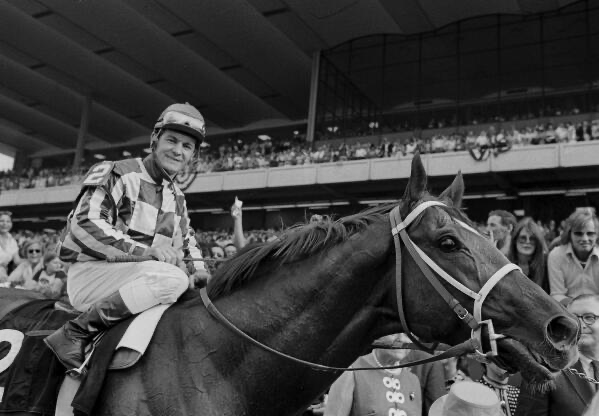
Win only the Derby and you're a champion. Win all three and you're remembered forever.
In transformation, only the three-race sweep counts. 70% of transformations fail when companies stop after the strategy race.
Ron Turcotte and Secretariat, 1973
Three disciplines. One system. Zero shortcuts.
Hard — and most companies only do the easy parts.
Finding the right strategy isn't easy. But compared to the other two races, it's the part consultants already know how to do. Most companies believe their strategy is aligned and they're playing the right game.
Usually, it's not.
The Strategy Race is won not when the deck is approved, but when every level of the organization is operating from the same facts, the same beliefs about what's true, and the same answer to what to do Monday morning. SPEE is the operating system we use to get there.
Harder — because roles change faster than the people in them.
The Talenting Race is about getting the right work done the right way at the right time, up and down the organization. Not just the top 2%. Every layer. When more than 40% of a role changes, it's not the same job — it's a new one. Most organizations learn this reactively, after the reorg.
This is not new. Strategic change has always required work to be reorganized and talent to be reassessed. What AI is doing is accelerating it — unwinding what the Industrial Revolution built. For two centuries, people and machines were blended into roles. Now they're being separated, faster than most organizations can absorb. But the underlying truth has always held: research consistently identifies people and process as the dominant factors in whether a transformation lands. Technology is the least important to get right.
Talent alignment is a known technology. There are best practices, science-based tools, processes that work. Doing it is the blockage — not because we don't know how, but because of beliefs, emotions, and resistance to change. The companies that win this race reassess roles from the ground up, match talent to the new work, and keep doing it as the work keeps changing.
Hardest — and the one most consultants skip.
Culture alignment is the messiest race. Very large. Very complex. Touches everyone. Resistance is common. Traditions maintain the old culture. Founders are revered even after they're gone.
Culture is not touchy-feely. It's not abstract. It's not the words on the wall. Most simply: culture is how work gets done inside the organization. It's what's rewarded and supported. It's what is valued and allowed.
Every real strategic change requires a change to the ways of working — and that's what culture is. Some elements of the existing culture are precious and must be preserved. Others are harmful to the new strategy and must be surgically removed. Knowing which is which is the whole diagnostic: mapping the behaviors that are present and positive, present and negative, absent and needed, absent and not missed. From that map, leaders can identify what to reinforce, what to dismantle, and what new behaviors have to be built.
The science exists. The methodology works. It's just rarely deployed properly — skipped over or grossly misunderstood. We stay long enough to do it right.
The practitioner's playbook for every force that enables — or defeats — transformation.
Kotter found that 70% of transformations fail. McKinsey's independent research arrives at the same number. That failure is almost always the same story: the strategy race got run, and the talenting and culturing races did not. The 24 Laws of Leading Transformational Change is the framework we built to change that statistic — for our clients. Twenty-four named laws, five stages, one complete system: from organizing and preparing for change, through mobilizing leadership, managing resistance and apathy, to cementing the change so it holds.
Explore the 24 Laws →How we look at funnels
Every funnel tells a story about attrition. We built this one to trace 151 years of the Kentucky Derby through the Triple Crown — every horse that entered the gate, every path forward, every dead end. It's the same lens we apply to client pipelines, customer journeys, and transformation programs: count what enters, count what survives, name the gap.
The Triple Crown funnel,
1875 — 2025.
Every horse that entered the gate at Churchill Downs, traced through the Triple Crown. Hover any outcome to follow the thread of a thoroughbred's spring.
Thirteen horses in one hundred fifty-one years.
Hover or tap any card below to see every horse that finished there.
Final tally.
The 151 Derby winners, re-rolled into four outcomes.
The goal
Remarkable.
Every company starts somewhere in this funnel. The first ambition is to win a single race. The career ambition is the Triple Crown.
Triple Crown eligibility spans 1875–2025, the years in which all three races existed. The Preakness was not run in 1891–1893, and the Derby and Preakness were held on the same day in 1917 and 1922, making a sweep impossible in those five years.
The term “Triple Crown” was coined by Charles Hatton in 1930 after Gallant Fox’s sweep. Sir Barton’s 1919 sweep was recognized retroactively.
Sources: Churchill Downs Incorporated, The Jockey Club, Thoroughbred Times.
Data through the 151st running, May 2025.
In horse racing, every finish line is a win. In transformation, only one is.
Every horse that wins the Kentucky Derby is a champion. Some win only the Derby and take their place in history. A rare few — thirteen in a hundred and fifty-one years — win all three races and are remembered forever.
In business, the funnel looks similar but reads differently. Companies that win the strategy race and stop there are not champions. They are the seventy percent of transformations that fail to meet expectations. Kotter named the number in 1995. McKinsey's research has confirmed it repeatedly since.
Remarkable companies win all three races. Strategy. Talenting. Culturing. Skip any one of them and the work stalls — not because the strategy was wrong, but because the organization was never built to execute it.
Roughly one in ten horses sweeps all three. Roughly one in ten companies becomes truly remarkable. The math does not change, because the work does not change.

What we work on.
AI Transformation Strategy
Helping leadership teams align on AI's role, assess organizational maturity, and build a coherent enterprise-wide approach.
Strategy Development & Facilitation
World-class facilitation to create a common fact base, shared beliefs, and aligned strategic priorities — before anyone starts executing.
Organizational Design
Reimagining structure, roles, and spans of control for the AI era — from role-level analysis to enterprise redesign.
Talent Assessment & Casting
Structured tools and practitioner judgment to assess who can make the leap to reimagined roles — and who will need support or transition.
Culture Transformation
Building the change-elastic culture that makes transformation stick — trust, transparent communication, interdependence, and shared purpose.
Executive Team Development
The 7 Practices of high-performing leadership teams — applied to your specific team, your specific strategy, and your specific moment.
Ready to start?
Every engagement begins with a conversation. No pitch decks. No generic proposals. Just an honest discussion about where you are, what you need, and whether we're the right fit.
Start the Conversation