

The 24 Laws of Leading Transformational Change
A practitioner's framework for the forces that enable — or defeat — every transformation.
Kotter estimated that more than 70% of transformations fail to deliver on their initial aspirations. McKinsey's independent research across thousands of executives arrives at the same number. The reasons are more structural than strategic. Organizations are not designed to change. They are designed to run.
The 24 Laws name every force — structural, cultural, behavioral, and human — that either enables transformation or defeats it. Together, they form a complete system: from setting direction and building governance, through mobilizing leadership and overcoming resistance, to sustaining momentum and cementing lasting change.
Every transformation is a Triple Crown pursuit.
Winning transformation requires winning three races in sequence: the Strategy Race, the Talenting Race, and the Culture Race. Most organizations attempt all three without naming any of them.
The rank order of difficulty is instructive. Strategy — building a focused plan and achieving executive alignment — is the most straightforward. Talent is harder: deploying the right people into reimagined roles requires decisions that cut against loyalty, tenure, and institutional comfort. Culture is the hardest of all. It is not birthday cakes and values statements. It is how work actually gets done — what is rewarded, what is tolerated, and what is quietly allowed.
Most organizations do not finish the Culture Race. That is where the 70% failure rate lives. The 24 Laws are designed to change that.
Five stages. Twenty-four laws. One complete system.
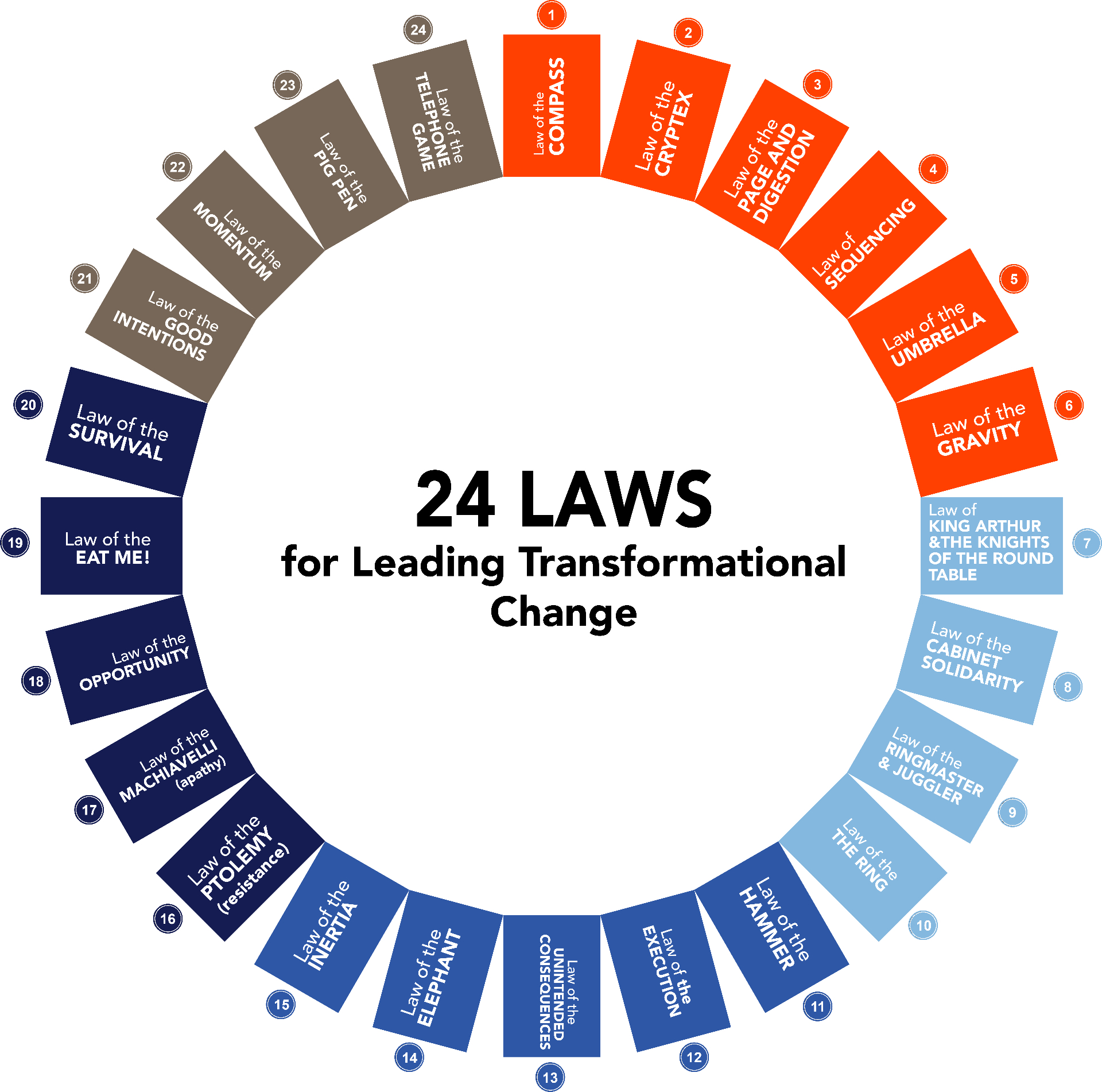
Many transformations fail or succeed before the first initiative launches. The decisions made here — about context, direction, sequencing, pace, architecture, and the forces arrayed against change — are not preparatory work. They are the work.
The Law of the Compass
Setting True North — the direction that holds when pressure mounts and circumstances shift
The Law of the Cryptex
Decoding the specific context for change — company business designation, cultural DNA, type of change, dominant enemy of change
The Law of Sequencing
Doing the right things in the right order
The Law of Pace and Digestion
Balancing pace with the organization's capacity to absorb — and leaders' readiness to deliver
The Law of the Umbrella
Defining what belongs under transformational governance
The Law of Gravity
Building the alternative structure required to lead change while running the business
Transformation does not fail for lack of strategy. It fails for lack of the right leadership — in the right roles, with the right authority, aligned around the right decisions.
The Law of King Arthur and the Knights of the Round Table
Preparing the executive sponsor for the full weight of ownership — strategy through execution
The Law of Cabinet Solidarity
Ensuring leaders know, understand, and are aligned on the strategy, how it will be executed, and what it demands of them
The Law of the Ringmaster and the Juggler
Building the change leadership team fit for Prepare, Grapple, and Cementing the Change
The Law of (Kiss) the Ring
Engaging power before it becomes opposition
This is where most transformations are won or lost — translating strategy into execution, naming risk before it materializes, and establishing the recurring rhythms that keep the program moving and honest.
The Law of the Hammer
Recognizing when prior expertise has become dogma — and the wrong tool for the problem
The Law of Execution
Translating strategy into action in adaptive change
The Law of Unintended Consequences
Anticipating and managing second-order effects
The Law of the Elephant
Earning organizational belief through early proof
The Law of Inertia
Overcoming the pull of the status quo
Resistance and apathy are the two great enemies of transformational change. They are not obstacles to work around — they are forces to be understood, named, and resolved. This section addresses both — and turns transformation into the organization's most powerful development tool.
The Law of Ptolemy
Managing and resolving resistance
The Law of Machiavelli
Managing and resolving apathy
The Law of Opportunity
Using transformation as the organization's most powerful development tool
The Law of Eat Me!
Working with executives to grow into the challenge vs trying to shrink it down to something they feel they can manage
The Law of Survival
Understanding who will and won't make the transition
Momentum is the most fragile asset in any transformation. This section governs how leaders protect it, reverse negative drift before it hardens, separate signal from noise, and ensure what was designed at the top is actually landing at the front line.
The Law of Good Intentions
Holding standards when tolerance feels like kindness
The Law of Momentum
Protecting positive momentum and reversing negative before it hardens
The Law of the Pig Pen
Separating signal intelligence from the noise of disruption
The Law of the Telephone Game
Rebuilding communication channels for adaptive and transformational change
"The 24 Laws are transformation's phoropter. Each Law brings one more dimension of the change landscape into focus. Miss a lens and something important stays blurry. Work through all of them and the picture that emerges isn't just clearer — it's complete."
Most transformations don't fail because leaders lack commitment. They fail because they are navigating by a blurry picture and don't know it.
Which law is your organization getting wrong right now?
The most important question any of the 24 Laws can raise is a simple one. We use the framework as a diagnostic tool at the start of every engagement — identifying where the transformation is most likely to break down before it does.
Start a Conversation